
2. Engine Power and Transmission: The Foundation of Tractor Pulling Power
2.1 Engine Horsepower vs. Torque
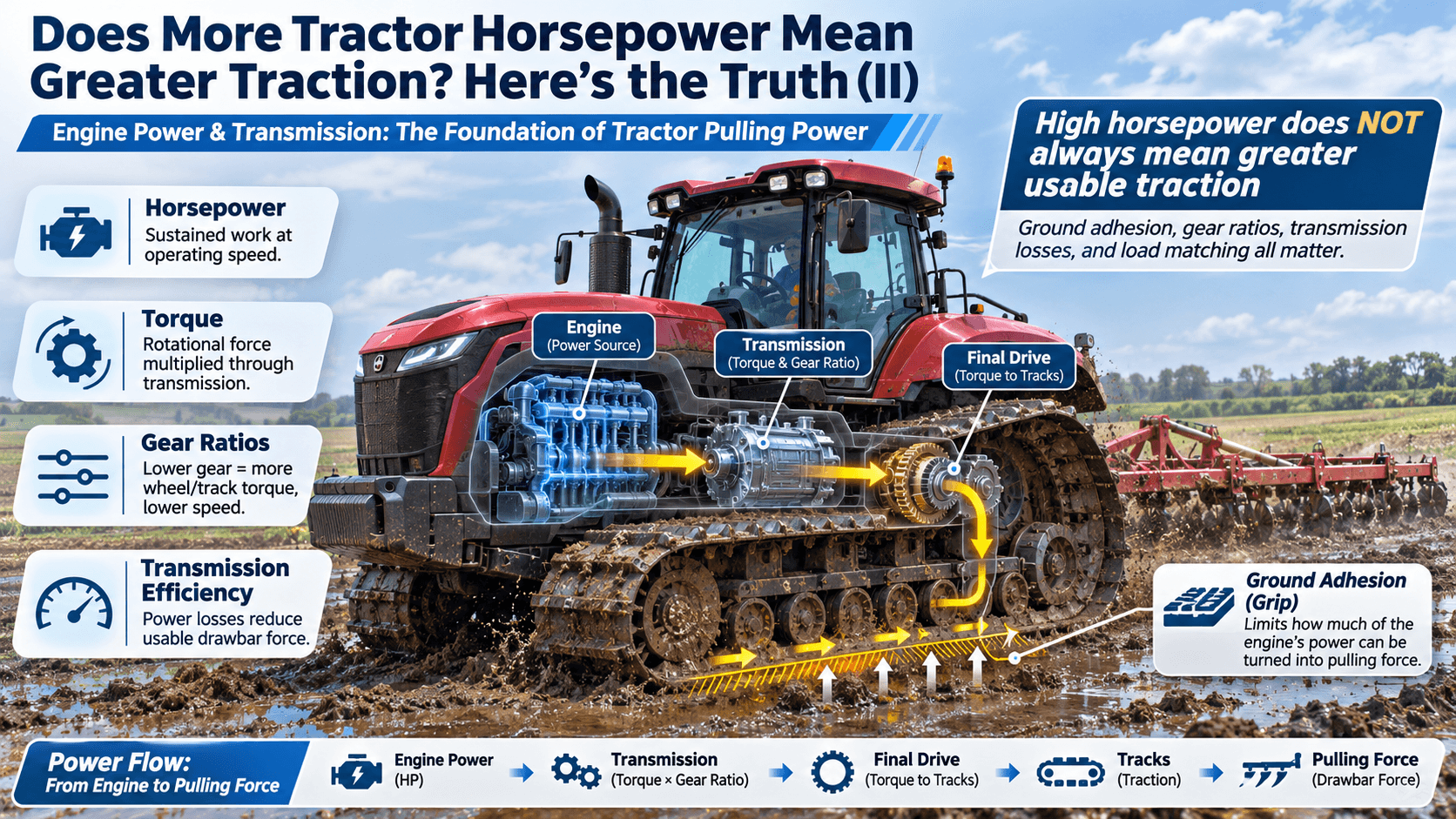
Horsepower and torque are closely related, but they describe different aspects of engine performance.
Engine Horsepower
Horsepower represents the rate at which an engine can perform work. It influences how much pulling work a tractor can sustain at a given operating speed.
A higher-horsepower engine generally provides more power for demanding applications such as deep plowing, subsoiling, and operating large agricultural implements.
Engine Torque
Torque describes the rotational force produced by the engine.
Through the transmission and final drive, engine torque is multiplied and delivered to the driving wheels or tracks.
For heavy-duty agricultural operations, strong low-speed torque and adequate torque reserve help the tractor handle changing loads without excessive engine speed reduction.
However, torque alone does not determine drawbar pull. Gear ratios, transmission losses, drive-wheel dimensions, and ground adhesion also affect the resulting tractive force.
A simple example:
Imagine a powerful wheeled tractor operating on wet, muddy farmland.
The engine produces sufficient power, but the tires begin spinning because they cannot maintain enough grip.
Even though the engine has available power, the tractor cannot efficiently transfer it to the ground.
This is why a high-horsepower tractor does not always deliver greater usable traction.
2.2 Transmission Gear Ratios
The transmission plays an important role in converting engine output into usable driving force.
Under the same engine torque and transmission efficiency:
- A higher overall gear reduction ratio produces greater wheel torque and lower travel speed.
- A lower overall gear reduction ratio produces less wheel torque and higher travel speed.
This explains why tractors typically operate in lower gears during heavy-duty tillage.
Selecting the correct gear helps maintain suitable engine speed, improves load matching, and reduces unnecessary power losses.
For operations such as deep plowing and subsoiling, proper gear selection is often just as important as engine horsepower.
2.3 Transmission Efficiency
Engine power passes through multiple mechanical components before reaching the wheels or tracks.
These may include the clutch, gearbox, drive shafts, differential, and final drive.
Each component introduces some degree of mechanical or hydraulic power loss.
Different transmission systems, including mechanical gearboxes, powershift transmissions, and continuously variable transmissions (CVTs), offer different advantages in terms of efficiency, speed control, and operating convenience.
Actual transmission efficiency depends on the design and operating conditions.
A well-matched transmission helps deliver more usable power to the ground while maintaining appropriate working speeds.