
3. Ground Adhesion: Why More Horsepower Does Not Always Mean More Traction
In many agricultural applications, the limiting factor is not engine power but the ability of the tires or tracks to transmit force to the soil.
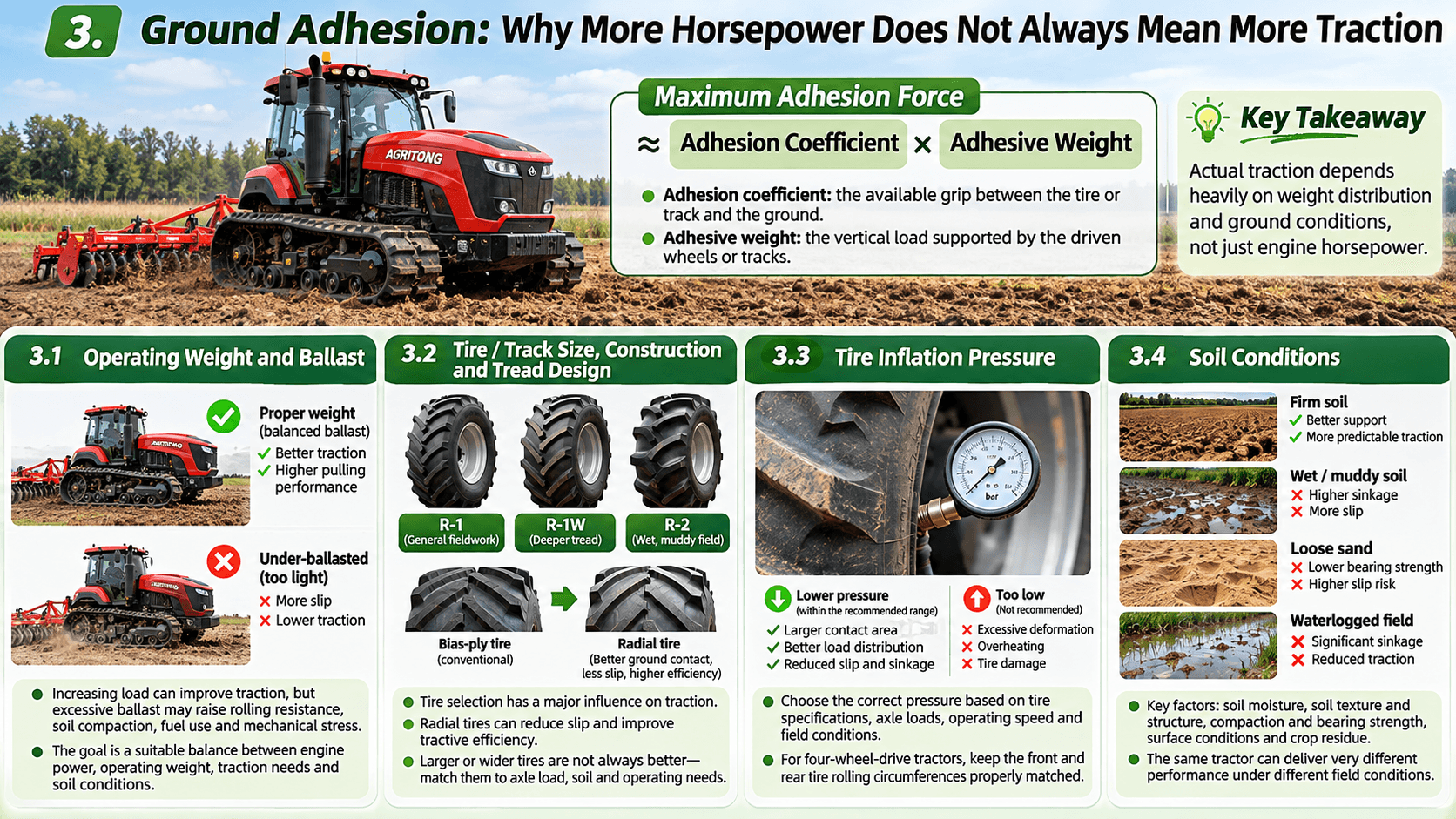
The maximum available adhesion can be approximated by:
Maximum Adhesion Force ≈ Adhesion Coefficient × Adhesive Weight
Where:
- Adhesion coefficient: Represents the available grip between the tire or track and the ground.
- Adhesive weight: Represents the vertical load supported by the driven wheels or tracks.
This simplified relationship shows that actual traction depends heavily on weight distribution and ground conditions.
3.1 Tractor Operating Weight and Ballast
Tractor operating weight directly affects the load carried by the driving wheels or tracks.
Under suitable conditions, increasing the load on the driven components can improve available traction.
This explains why two agricultural tractors with similar horsepower ratings may have noticeably different pulling capabilities.
A tractor with excessive horsepower relative to its operating weight may suffer from significant wheel slip during heavy pulling operations.
This situation is sometimes described as an under-ballasted tractor.
However, adding more weight is not always the solution.
Excessive ballast can increase rolling resistance, soil compaction, fuel consumption, and mechanical stress.
The goal is to achieve a suitable balance between engine power, operating weight, traction requirements, and soil conditions.
For four-wheel-drive tractors, correct front-to-rear weight distribution is especially important.
3.2 Tire Size, Construction, and Tread Design
For wheeled agricultural tractors, tire selection has a major influence on traction performance.
Important factors include tire width, diameter, construction, and tread pattern.
Common agricultural tire classifications include:
R-1 Agricultural Tires: Designed for general agricultural fieldwork and a wide range of conventional soil conditions.
R-1W Agricultural Tires: Feature deeper tread patterns and may provide advantages in certain demanding field conditions.
R-2 Agricultural Tires: Designed primarily for wet, muddy, and specialized agricultural environments.
Radial agricultural tires can also offer advantages over traditional bias-ply tires.
When properly selected and operated, radial tires can improve ground contact characteristics, reduce slip, and improve tractive efficiency.
However, larger or wider tires do not automatically guarantee better performance. Tire selection should be matched to axle load, soil characteristics, and operating requirements.
3.3 Tire Inflation Pressure
Tire inflation pressure is another important factor affecting tractor traction.
Within the manufacturer's recommended operating limits, reducing tire pressure for fieldwork can increase the contact area and improve load distribution.
This can help reduce excessive slip and soil sinkage.
However, insufficient inflation pressure may cause excessive tire deformation, overheating, and tire damage.
The correct pressure should be selected according to tire specifications, axle loads, operating speed, and field conditions.
For four-wheel-drive tractors, proper front-to-rear tire rolling circumference matching is also essential for avoiding unnecessary drivetrain stress and power losses.
3.4 Soil Conditions
Soil conditions can significantly change a tractor's traction performance.
Firm, stable soil often provides better support and more predictable traction.
In contrast, soft mud, loose sand, and waterlogged farmland can increase sinkage and slip.
Key factors include:
- Soil moisture content.
- Soil texture and structure.
- Soil compaction and bearing strength.
- Surface conditions and crop residue.
The same tractor may deliver very different drawbar pull and tractive efficiency depending on where it operates.
For this reason, agricultural tractor performance should always be evaluated under relevant field conditions.